Facelift — repositioning the deep layer, not stretching the skin
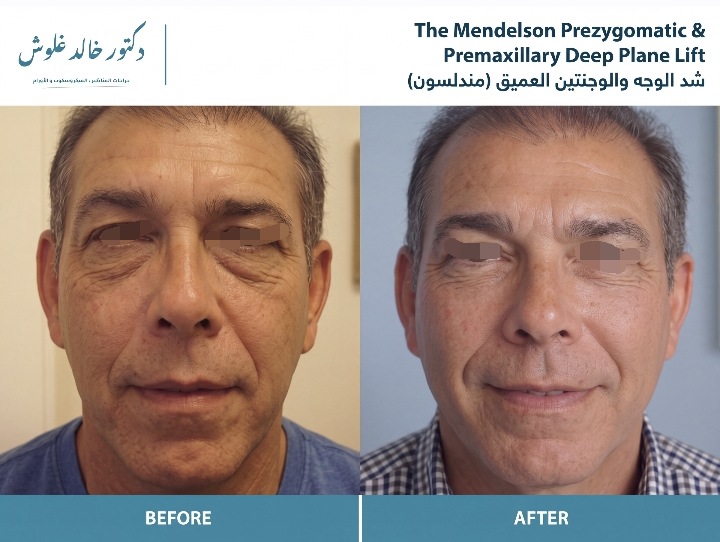
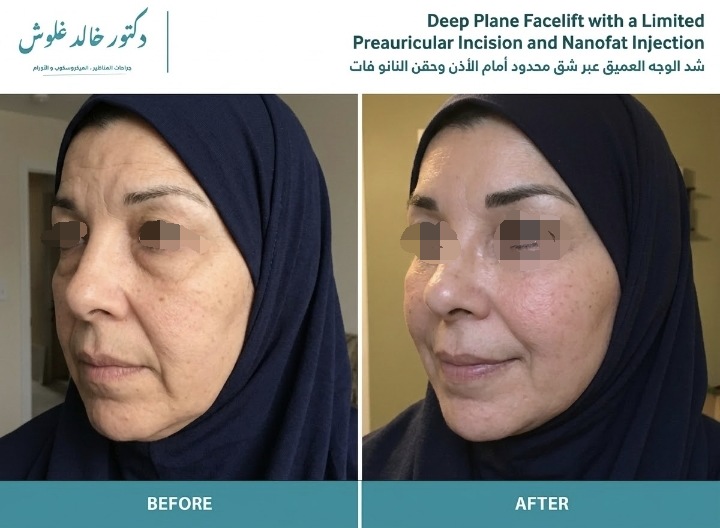
A facelift that lasts moves the layers that actually descend — the muscle-fascia layer (SMAS), the platysma and the cheek fat — after the ligaments tethering them are released, and lets the skin settle over them without tension. Two real cases show the range: a midface deep plane lift through the lower lid for a man, and a short-scar deep plane facelift with nanofat for a woman.
What actually ages the lower face
With time the cheek fat pad slides down, the jowl forms in front of the jaw, the marionette grooves deepen and the junction between lid and cheek hollows. The skin changes too — thinner, drier, sun-marked. These are different problems in different layers, and they need different instruments.
Two cases, two plans
| Case | Problem, plan and scar |
|---|---|
| Male — midface deep plane lift (Mendelson) | Problem: heavy lower lids, festoons, a deep tear-trough groove, deep nasolabial folds. Plan: release the cheek ligaments, rebuild the lid–cheek line, suspend the deep cheek layer upward. Scar: a fine line just under the lower lash line. |
| Female — limited-incision deep plane lift with nanofat | Problem: jowls, a blunted jaw border, marionette grooves, midface volume loss, photo-aged skin. Plan: deep plane lift at about 60° with zero skin tension, plus nanofat for skin quality. Scar: hidden at the ear, from the hairline to the lobe — none behind the ear. |
The Mendelson midface deep plane lift, step by step →
The limited-incision deep plane facelift, step by step →
Deep plane versus skin-only, in plain words
In a skin-only lift the skin is pulled and trimmed, so the result depends on the tension of the closure. In a deep plane lift the skin, the SMAS and the platysma are freed and lifted as one unit after the ligaments are released, so the lift is carried by the deep layer and the skin is closed without tension. That is why the result tends to look natural and tends to last longer — and why it demands precise knowledge of where the facial nerve runs.
What the examination decides
- Which layers have descended — midface, jowl and jawline, neck — and which have only lost volume.
- How far the scar needs to go: the lower lash line, the ear only, or both.
- Whether the lids, the skin quality (nanofat) or the neck are part of the plan.
- Your skin thickness, healing history and medications, and whether you smoke.
None of this can be read from a photograph. The plan is drawn at the examination, for your face.
Recovery and risks, honestly
Swelling and bruising are expected and settle over the first two to three weeks; the contour keeps refining for several months. The risks that matter in facelift surgery are haematoma, temporary — and rarely lasting — weakness of a facial nerve branch, scar widening, and skin-healing problems, which are higher in smokers. They are the reason the plan and the plane of dissection matter more than the name of the technique.
Results
Consented before-and-after cases. Each links to the full case in the results gallery.
Frequently asked questions
Is a facelift only for older people?
No. It is decided by what has descended, not by age. Some people in their forties have jowling from genetics or weight change; some in their sixties need only a midface or neck procedure. The examination, not the birth year, decides.
How long does a deep plane facelift last?
Because the lift is carried by repositioned deep tissue rather than skin tension, it tends to last longer than a skin-only lift. Nobody stops ageing, so the face keeps ageing naturally from the new starting point.
Where are the scars?
In the limited-incision approach the scar starts in the temporal hair, follows the natural line of the ear and ends at the lobe, with no scar behind the ear. A midface lift through the lower lid uses a fine incision just under the lash line. Both are planned to sit in natural lines.
Will I look pulled or “operated”?
That look comes from pulling skin sideways. A deep plane lift moves tissue along the direction it descended and closes the skin without tension, which avoids the windswept look. In men it also keeps the cheek contour masculine.
Can it be combined with eyelid surgery or nanofat?
Yes, often. The midface lift can be done together with lower-lid work, and nanofat is used for skin quality. It is one anaesthetic and one recovery.
What are the risks?
Haematoma, temporary numbness or weakness from nerve irritation, rarely lasting weakness of a branch, scar widening and delayed skin healing, higher in smokers. Respecting the nerve planes and closing without tension are the safeguards.
The right facelift is decided at the examination
Which layers need lifting, how far the scar goes and whether the lids or skin quality join the plan is decided by the examination, not by a photograph.
Book the examination →