Deep plane facelift through a limited incision, with nanofat
For jowls, a blunted jawline, marionette grooves, midface volume loss and tired skin: a short scar hidden at the ear, a deep-layer lift closed without skin tension, and the patient’s own fat refined into nanofat to improve skin quality.
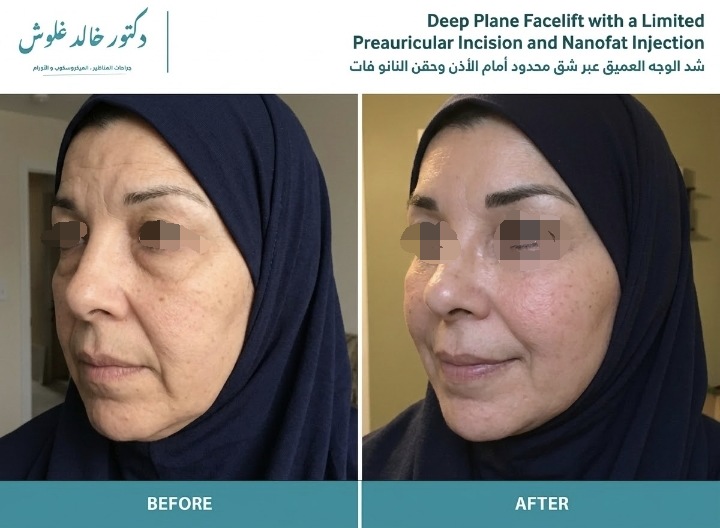
What the case shows
Before: jowling, a blunted mandibular border, marionette grooves, midface volume loss and photo-aged skin. After: a crisp jaw border, softer grooves, a restored cheek and fresher skin texture.
The operation in seven steps
-
1
A short, hidden incision
It starts in the temporal hair tuft, follows the root of the ear, runs behind the tragus and ends at the earlobe, stopping before the skin behind the ear.
-
2
Safe entry into the deep layer
A limited skin flap is raised over the parotid area, then the SMAS is opened along a line from just below the outer eye corner to the angle of the jaw, behind the line that protects the frontal branch of the facial nerve over the cheekbone arch.
-
3
The sub-SMAS plane over the masseter
Blunt spreading in the avascular plane over the masseter fascia lifts the skin–SMAS–platysma unit as one, leaving the facial nerve branches protected beneath the deep fascia.
-
4
Release the cheek ligaments
The zygomatic ligaments are released sharply, with care for the small artery that crosses them, together with the row of masseteric ligaments along the front of the masseter, so the lift reaches the cheek fat, the nasolabial fold and the corner of the mouth.
-
5
Free the jowl, define the jawline
The mandibular ligament is released about 1.5 cm in front of the pre-jowl sulcus to free the jowl and the marionette fold; the side of the platysma is then anchored to the fascia in front of the ear to carve a crisp jaw border.
-
6
Lift at about 60° with no skin tension
The mobilised layer is anchored along a superolateral vector of about 60° to the firm temporal fascia above and the parotid fascia below; excess skin is trimmed and closed without tension, protecting the shape of the tragus and the earlobe.
-
7
Nanofat for the skin
Fat is harvested with a multi-port 2 mm cannula under low pressure, emulsified by repeated passes between connectors (2.4 mm down to 1.2 mm) and a fine mesh (400–600 µm), then injected with a fine cannula or 27G needle into the tear trough, the cheek skin and the lip lines to improve texture and glow.
Protecting the nerves
The SMAS is opened behind the line that protects the frontal branch of the facial nerve as it crosses the cheekbone arch, and the plane over the masseter keeps the buccal and marginal mandibular branches beneath the deep fascia, out of the field.
The incision: short and hidden
The scar follows natural lines — the hairline, the root of the ear and the fold behind the tragus — and does not extend onto the skin behind the ear. Closing without tension preserves the tragal contour and prevents a pulled earlobe.
Nanofat: what it adds
Nanofat is not volume. It is fat broken down to a fine fluid rich in the tissue’s own regenerative cells, placed into the dermis. Its job is skin quality — texture and glow — in the tear trough, the cheek skin and the lip lines. The lift repositions; nanofat refreshes. More on the nanofat page.
Frequently asked questions
Is there a scar behind the ear?
No. The limited approach stops at the earlobe and does not extend into the skin behind the ear. The scar lies in the hairline and the natural folds in front of and around the ear.
Will my ear look pulled?
The skin is trimmed and closed without tension, and the lift is carried by the deep layer, which protects the shape of the tragus and prevents the pulled-earlobe look.
What does nanofat do that the lift does not?
The lift repositions tissue; it does not change skin texture. Nanofat is injected into the dermis to improve texture and luminosity in areas such as the tear trough, cheek skin and lip lines.
Is a limited incision enough for everyone?
No. It suits faces where the main descent is at the jowl, cheek and jaw. More neck laxity or heavier skin may need a longer incision or neck work. The examination decides.
What are the risks specific to this operation?
Haematoma, temporary weakness or numbness from nerve irritation, rarely lasting weakness of a branch, scar widening and delayed skin healing, higher in smokers. Entering behind the protective line, working in the plane over the masseter and closing without tension are the safeguards.
Does your face need a deep plane lift?
Jowls and a blunted jaw usually do; skin quality alone may not. The examination separates the two.
Book the examination →