Restoring the face — form and function together
A facial wound is never only skin-deep. The face carries expression, identity, and the way the eyes, lips, and nose work. Reconstruction is the discipline of rebuilding what was injured so it both looks right and works right — closing in the correct planes, hiding scars in natural lines, and restoring movement. Dr. Khaled Ghalwash approaches every facial defect with reconstructive and microsurgical technique, planning the repair before the first suture.
الوش مش بس جلد — هو تعبير وهوية ووظيفة. الترميم معناه نرجّع الشكل والحركة مع بعض.
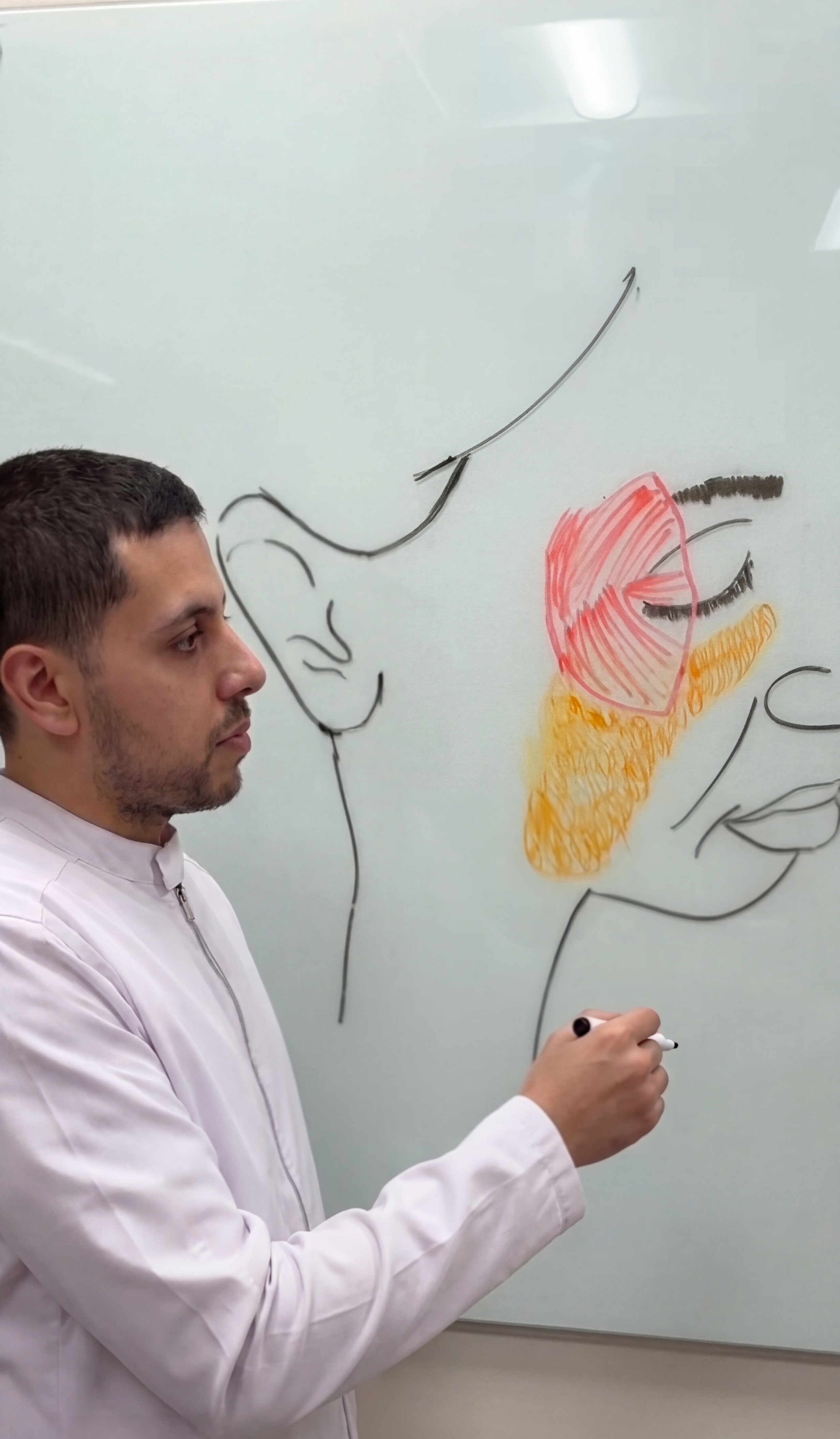
What facial reconstruction covers
إيه اللي بيشمله ترميم الوجه
Acute wounds and trauma: Lacerations, crush and degloving injuries, and tissue loss from road or work accidents. Early, well-planned repair gives the best scar.
Animal and human bites: Common on the face, especially in children. These need careful cleaning, layered repair, and judgement about timing to balance infection risk against the best cosmetic result.
Post-excision defects: The gap left after removing a facial lesion. Reconstruction restores the contour of the lip, eyelid, nose, ear, or cheek.
Old or poor scars: Scars that are wide, raised, or pulling on a feature can be revised and re-aligned into a natural crease.
The principles that decide the scar
المبادئ اللي بتحدد الندبة
Aesthetic subunits: The face is read as units — lip, eyelid, nasal tip, cheek. Repairs that respect the borders between subunits stay invisible; repairs that cross them are seen.
Relaxed skin tension lines (RSTLs): Skin has a natural grain. A scar placed along that grain settles into a crease; a scar across it stays visible and may widen. Planning the closure direction is half the result.
Layered, tension-free closure: Each plane — muscle, deep tissue, dermis, skin — is rebuilt separately so the surface skin carries no tension. Tension is the main reason scars widen.
The reconstructive ladder: The simplest method that fully restores the area is chosen — direct closure, then local flaps, then grafts, then microsurgical free-tissue transfer for complex, full-thickness defects. Microsurgery lets tissue be moved with its own blood supply when a defect is too large to close any other way.
Not every problem needs surgery first. Read our honest assessment guide.
Common questions
Will there be a scar?
Any full-thickness wound heals with a scar — the question is how visible it is. Placing the repair along the skin's natural tension lines and within aesthetic-subunit borders, closing without tension in layers, and managing the scar as it matures over 6–12 months are what make a scar fade into a fine line rather than stand out.
Should a wound be repaired immediately or later?
It depends. A clean facial laceration is best repaired early, while the tissue is fresh and edges align cleanly. A contaminated wound or a bite may be cleaned first and repaired in a planned, delayed way to lower infection risk. Some larger defects are reconstructed in stages. The right timing is a surgical judgement, not a fixed rule.
What about function — nerves, eyelids, lips?
Form follows function. A wound near the eyelid must still let the eye close; a lip repair must keep the lip seal and a level border; a deep cheek wound may involve a facial-nerve branch or the parotid duct. Reconstruction checks and restores these structures, not just the skin — which is exactly where microsurgical training matters.
Can an old or poor scar still be improved?
Often, yes. A scar that is wide, raised, or pulling on a feature can be revised — re-aligned into a natural crease, released if it restricts movement, and resurfaced. Scar revision usually waits until the original scar has matured (around 12 months), since scars continue to soften and fade during that period on their own.
Choosing your surgeon matters — read how to choose a surgeon first.
Unhappy with a scar or a result from a previous operation? See revision & corrective surgery.
Before your surgery: what tests Dr. Khaled Ghalwash will order
Every patient receives the standard pre-operative panel, with personalised tests added by profile.
