The examination — what ten minutes answers that the internet cannot
One examination answers three questions, and nothing else answers any of them: whether the swelling is benign or needs imaging, whether it is gland or fat or both, and how much skin will be left over when the gland comes out. Those three answers are the diagnosis, the grade, and the operation. Dr. Khaled Ghalwash performs the examination himself, and does not name an operation before he has done it.
Three questions, one examination
Benign or not? Read from the texture, the position of the disc relative to the areola, whether it is one side or both, and the state of the skin and nipple. This is the finding that decides whether any imaging is ordered. benign or not.
Gland, fat, or both? A true gland is felt as a distinct, mobile, rubbery plate under the areola; fat is not. This is what decides whether suction alone can work or whether the gland must also be removed. which operation.
How much skin? The skin's elasticity and how much of it is redundant decide whether the areola has to be repositioned at all, and whether the periareolar crescent technique is needed. This cannot be judged from a photograph, because skin redundancy only shows against gravity, with the patient standing.
What actually happens in the room
It is brief, and it is the chest only. You are looked at standing and lying down, with your arms down and then raised, so the shape can be read against gravity. The chest and the armpit are felt, to read the texture, the exact position of any disc relative to the nipple, and how much skin is involved. It is not painful, and it is over quickly. There is nothing to it beyond the chest — and everything that decides your treatment comes from those few minutes.
What grading means, and why it decides the operation
Grading is simply a way of describing two things together — how much has grown, and how much spare skin there is — because those two facts, read at the examination, are what select the operation. The right-hand column is the point: the grade is not a label, it is the decision.
| What the examination finds | Skin | What the operation becomes |
|---|---|---|
| Small enlargement | Still tight | VASER and gland excision through the areolar border |
| Moderate enlargement | Still tight | VASER and gland excision; the skin retracts on its own |
| Moderate enlargement | Loose | VASER and gland excision, plus skin managed at the areolar border |
| Marked enlargement | Loose | VASER and gland excision, plus skin reduction and repositioning of the nipple |
What the examination decides about tests
Tests do not come before the examination — they follow from it. The examination is what orders an ultrasound, a mammogram, or a hormone panel, and just as often decides that none of them is needed. Arranging scans and bloods blindly beforehand usually means the wrong test; the examination is what makes them precise. pre-operative assessment.
What to bring
- A list of every medication and supplement you take — including anything from the gym.
- Any previous ultrasound or mammogram report.
- Any blood or hormone results you already have.
- Roughly when you first noticed it, and whether it has changed since.
And then what
The examination has more than one honest ending. Some men are reassured and observed. Some have a cause treated and are reviewed in a few months. Some need imaging or a biopsy before anything else is decided. And some are best served by an operation. Not every man who walks in needs surgery — and being told so plainly is a better outcome than being operated on unnecessarily.
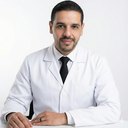
Dr. Khaled Ghalwash examines every chest himself. The examination is the diagnosis, the grading, and the technique selection — all three, in the same ten minutes. It is not the step before the plan. It is the plan.
Frequently asked questions
I am very embarrassed. Can I just send a photo?
No — and it is worth saying exactly why. A photo cannot show texture, cannot show whether the swelling sits off-centre from the nipple, and cannot tell gland from fat. Photos are sent every day and every day they cannot be answered honestly. The examination is short and it is the chest only. The embarrassment is normal — and acting on it, by staying away, is the most common reason men are treated later and harder than they needed to be.
How long does it take and what happens?
It is brief and it is the chest only. You are looked at standing and lying down, arms down and arms raised, and the chest and the armpit are felt to read the texture, the position of any disc relative to the nipple, and how much skin is involved. It is not painful and it is over quickly. From it come the three answers that decide everything: benign or not, gland or fat, and how much skin.
Do I need hormone tests before I come?
No. Do not arrange tests blindly first. The examination decides whether any blood test or scan is needed and which one — ordering them beforehand often means the wrong test. Come to be examined; the tests, if any, follow from what is found.
Can you just tell me the price on WhatsApp?
A price given without an examination is a price for an operation nobody has yet decided you need. What grew — gland, fat, or both — and how much skin is involved decide which operation is right, and the operation decides the cost. The examination comes first for a reason: so you are quoted a plan, not a guess.
Is it possible I do not need surgery at all?
Yes — and this is said plainly. Some men are reassured and observed. Some have a cause treated and are reviewed in a few months. Some need imaging or a biopsy before anything else. Not every man who walks in needs an operation, and being told so is a better outcome than being operated on unnecessarily.
Will I get a scan the same day?
Sometimes. If the examination points to imaging — a one-sided or suspicious swelling, or a man over 40 — it is arranged promptly, sometimes the same visit. In many cases the examination alone answers the question and no scan is needed at all.
I am young — 17 to 19 — what will I be told?
Gynecomastia around puberty often settles on its own, so in a younger man the examination frequently decides to wait and review rather than operate. It is still worth being examined, because the exam is what distinguishes the common, self-limiting kind from the tissue that will not resolve — and it reassures without guessing.
Book the examination
Bring a list of everything you take — medications, supplements, anything from the gym — and any scan or blood result you already have. You will be examined, you will be told what it is, and you will be told plainly whether you need an operation.
WhatsApp 01500509000