Tired-looking eyes are anatomy, not fatigue
If your eyes look tired no matter how much you sleep, the cause is usually structural, not lifestyle. Lower blepharoplasty addresses the under-eye in the way the anatomy actually fails: fat pushing forward, a hollow forming beneath it, and skin losing its grip. Dr. Khaled Ghalwash treats the lower eyelid with the precision it demands, restoring a rested, natural look while protecting how the lid sits and how the eye closes.
العين اللي شكلها تعبان دايماً — السبب تشريحي، مش قلة نوم. والحل إننا نرجّع التوازن، مش نشيل.
Why under-eye "bags" form
ليه بيظهر الانتفاخ تحت العين
Three things change with age or genetics, and they often happen together:
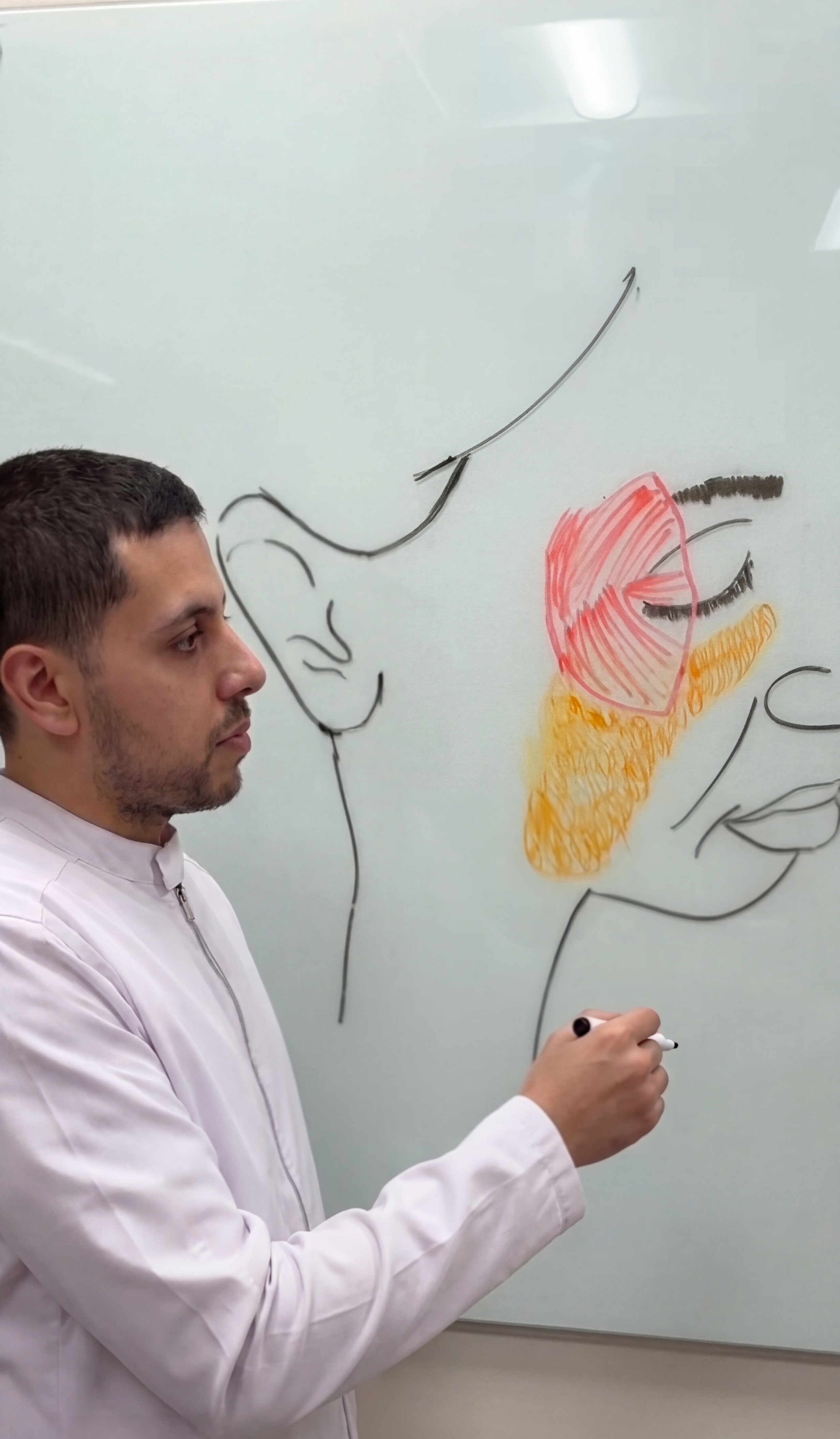
Fat herniation (the "bag"): The lower lid holds fat in 3 compartments — medial, central, and lateral. When the membrane that holds them weakens, fat pushes forward and bulges. This is the puffiness people call a bag.
The tear-trough hollow: A ligament tethers the skin to the bone at the orbital rim. As the cheek descends and the fat above it bulges, that tether creates a shadowed groove — the dark "hollow" that reads as tiredness even in a well-rested face.
Skin and muscle laxity: Lower-lid skin is the thinnest on the body. Over time it loosens and may show fine wrinkling or a slight sag, but loose skin is rarely the whole story — treating skin alone misses the fat and the hollow.
Because the cause is anatomical, creams and sleep do not fix it. Surgery works because it addresses the actual structures.
How the surgery is done — reposition, do not just remove
التقنية — إعادة توزيع، مش مجرد شيل
The single most important modern principle: preserve and reposition the fat, do not simply cut it away. Removing fat empties the lid and, years later, leaves the eye looking more hollow and aged. Repositioning the same fat downward fills the tear-trough hollow and gives a smoother, more natural lid-to-cheek transition.
Transconjunctival approach (no external scar): For most patients, the incision is made inside the eyelid. There is no visible scar, and because the lid's support muscle is left undisturbed, the risk of the lid being pulled down is lower.
Skin-incision approach: When there is genuine excess skin to remove, a fine incision just under the lash line is used. It heals to a nearly invisible line.
Lid support (canthal): Where the lid is lax, its outer corner is gently tightened or anchored. This protects against "scleral show" or a pulled-down lid, and keeps the eye's natural almond shape.
Not sure whether you need surgery at all? Read our honest assessment guide first.
Common questions
Will I have a visible scar?
In most cases, no. The transconjunctival approach places the incision inside the eyelid, so there is no external scar at all. When a skin incision is needed for excess skin, it sits just under the lash line and heals to a fine, well-hidden line.
What is recovery like?
Days 1–3: mild swelling and bruising, managed with cold compresses and head elevation.
Week 1: most bruising fades or is easily camouflaged; many patients return to desk work.
Weeks 2–6: residual swelling settles and the lid-cheek contour refines. Strenuous exercise resumes around 2 weeks, and final settling continues over a few months.
What are the risks, and how are they avoided?
The two risks specific to the lower lid are lid malposition (the lid pulled down, showing white below the iris) and temporary dry-eye sensation. Both are minimised by the muscle-sparing transconjunctival route and by supporting the lid's outer corner when it is lax, rather than removing skin and muscle aggressively. Careful candidate selection matters more than any single manoeuvre.
How long do results last? Can it be combined?
Repositioning fat addresses the underlying cause, so results are long-lasting; the eye still ages naturally afterwards. Lower-lid surgery is commonly combined with upper-eyelid surgery or tear-trough treatment in the same session — one recovery, one anaesthetic. Whether that fits you is decided at consultation.
Choosing your surgeon matters — read how to choose a surgeon before taking any step.
Before your surgery: what tests Dr. Khaled Ghalwash will order
Every patient receives the standard pre-operative panel, with personalised tests added by profile.
