Mendelson prezygomatic and premaxillary deep plane lift
For heavy lower lids, malar festoons, a deep tear-trough groove and deep nasolabial folds: release the ligaments that tether the cheek, then re-suspend the deep cheek layer upward — keeping the face masculine and avoiding a pulled, windswept look.
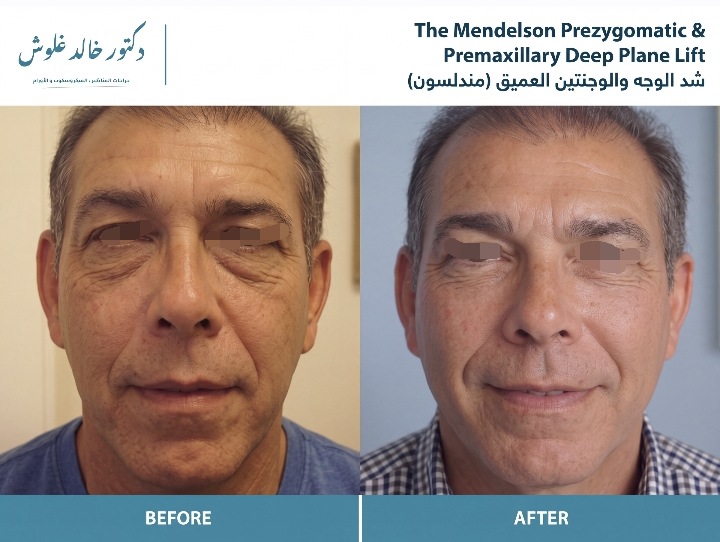
What the case shows
Before: fat bagging the lower lids (pseudoherniation), festoons over the cheekbone, a deep groove between lid and cheek (the palpebromalar groove) and deep nasolabial folds. After: one smooth lid-to-cheek line, softened folds, and a face that still reads as a man’s.
The operation in seven steps
-
1
Subciliary entry, muscle strip preserved
A skin incision 2 mm below the lash margin; the orbicularis muscle is divided 4–5 mm lower, so an intact strip stays in front of the lid cartilage to support the lid and the outer corner.
-
2
Preseptal dissection and ligament release
The avascular plane is followed down to the orbital rim; the tear trough ligament is released medially and the orbicularis retaining ligament laterally — the two tethers that carve the deep groove.
-
3
Open the prezygomatic space
Mendelson’s triangular space over the cheekbone is entered, bounded by the lid muscle above and the deep fat over the origin of the cheek-lifting muscles, freeing the malar mound and festoon as one unit.
-
4
Release the zygomatic ligaments
The stout ligaments along the lower border of that space are divided just above the origin of zygomaticus major, staying on the surface of the lip-elevator muscles so the motor branches entering their deep surface are protected.
-
5
Extend into the premaxillary space
The dissection is carried medially over the front of the maxilla, deep to the medial cheek fat pad, and stops just above the infraorbital foramen to protect the infraorbital nerve and vessels.
-
6
Release the maxillary retaining ligaments
The attachments along the pyriform aperture and the nasomaxillary buttress are divided so the dropped medial cheek is free to rise — this is what softens the nasolabial fold without cutting skin there.
-
7
Reposition the fat and suspend
The arcus marginalis is released and the orbital fat pads are moved across the rim; the composite flap — sub-muscular cheek fat, deep fascia and lid muscle — is then suspended upward and slightly outward to the outer orbital rim periosteum and the deep temporal fascia, giving one smooth lid–cheek line without a feminizing cheek flare.
Where the dissection stops
Two rules guide the dissection. Over the cheek, it stays on the surface of the lip-elevator muscles so the motor branches entering their deep surface are left alone. Medially, it stops just above the infraorbital foramen, protecting the sensory nerve and vessels to the cheek and lip. Knowing where to stop matters as much as knowing where to cut.
Why through the lower lid
A fine incision just under the lash line gives direct access to the lid, the orbital fat and the rim in one field, so the lids and the midface are treated as one problem. The strip of muscle kept in front of the lid cartilage is what protects the lid from drooping.
Who it is for
A midface lift is for real midface descent — festoons, a deep groove, a dropped cheek mass. Routine under-eye bags usually do not need it; the lower blepharoplasty page explains how that is decided.
Frequently asked questions
Does this operation leave a visible scar?
A fine incision just under the lower lash line, which heals to a thin line along the natural lid margin. No incision is made at the nasolabial fold; it softens because the tethers are released.
Can the nasolabial fold be improved without cutting skin there?
Largely yes, when the fold is deep because the medial cheek has dropped. Releasing the retaining ligaments lets the cheek rise and the fold soften. Folds that come from skin quality or volume loss may need other measures, which the examination sorts out.
Will it make me look feminine or pulled?
The vector is vertical and slightly outward, not strongly lateral, and the cheek is repositioned rather than enlarged, so there is no feminizing flare and no windswept pull.
What are the specific risks?
Lower-lid malposition, temporary numbness of the cheek or lip, asymmetry, haematoma and scar issues. Keeping the muscle strip in front of the lid and respecting the nerve planes is what keeps them low.
Is it suitable for women too?
Yes. The release-and-suspend principle is the same; only the vector and the amount of cheek projection are tuned to the face.
Is a midface deep plane lift your operation?
Festoons, a deep groove and dropped cheek need this operation; simple under-eye bags do not. The examination tells them apart.
Book the examination →